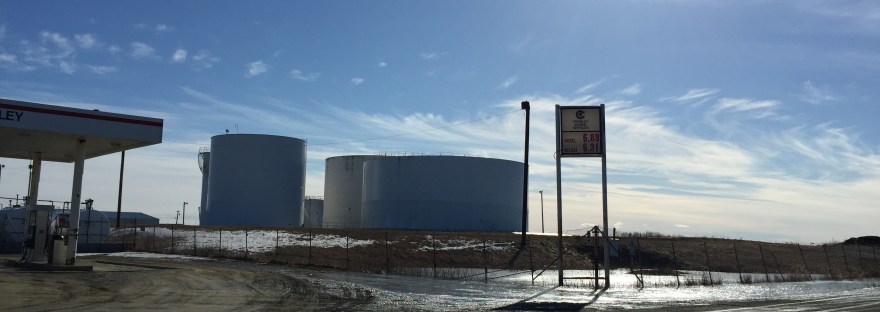
In Rural Alaska where the river is our longest road gas prices do one thing: They increase once a year.
Funny with all of the oil being sucked out of Alaska how much we pay for fuel out in the bush. The nice thing is we only have 17 miles of road (most villages are even less) the down side I have to swipe my credit card twice to fill up my gas guzzling rusty Chevrolet.
In the bush there are no winding roads connecting villages to burn gas on. Yet we still need tank farms to hold a years supply of stove oil, aviation gas, and even unleaded. During the winter the river becomes an ice road. Villages that have too shallow access for the barge to travel down have connex’s full of supplies delivered via 18 wheeler from hubs closer to the ocean. (seeing the river being plowed once the ice is thick enough is a site to see)In the summer the river is a life line with boats constantly traveling between villages and fish camps. Once a year after the river breaks the village receives the supply of gas’s to keep things running for another year. For us lucky enough to receive our supply via barge our price doesn’t sky rocket each year. We currently pay $6.31 a gallon and depending on when the river breaks this year will hopefully see it say under $7 a gallon. For those villages that the barge cannot reach and have to fly in their supply when they run out the price can get up into the double digits $20 a gallon or higher. Most villages where the price seems crazy don’t have “roads” so the demand for fuel is less that those commuting to work.
There are some villages that don’t have “cars” at all. With that being said you will see at least one snow machine parked in front of every home for winter travel between villages. One 4 wheeler for summer travel within the village, and at least one boat per household sitting in the river. These demand a stock of fuel to be maintained in each village. With there not being roads there is a very high aviation need to get everything to villages thru the year, this demands hub villages to stay stocked with aviation fuel. The power company runs off generators that require constant stove oil aka diesel. Homes run off toyo stoves for heat and boilers for hot water (there are no trees in this part of AK thus not many wood stoves…. that’s another story) The biggest different in living in the bush compared to the lower 48 when it comes to fuel supply and demand; In the village you have to prepare for the next year where “down states” small tanks are constantly being filled.
When the lower 48 gas prices are constantly changing we can count on one thing in the bush. That our price will increase when the barge arrives. Depending on when the river breaks will determine when the barge can make it to our village. This will increase our gas price a little or a lot. The barge company charges per day when hauling supplies. If the river breaks early the barge can arrive early on the flip side those years where the river doesn’t break until June we see a heavy increase in price.
While waiting for the barge to make port there is chatter all thru the village guessing what the new fuel price will be for the year. Here is to hoping for an early break up this year !


 disarraydayz